
Remembering, Loss & Real Priorities: Building A Business That Makes Room For Your Humanity
Sep 02, 2026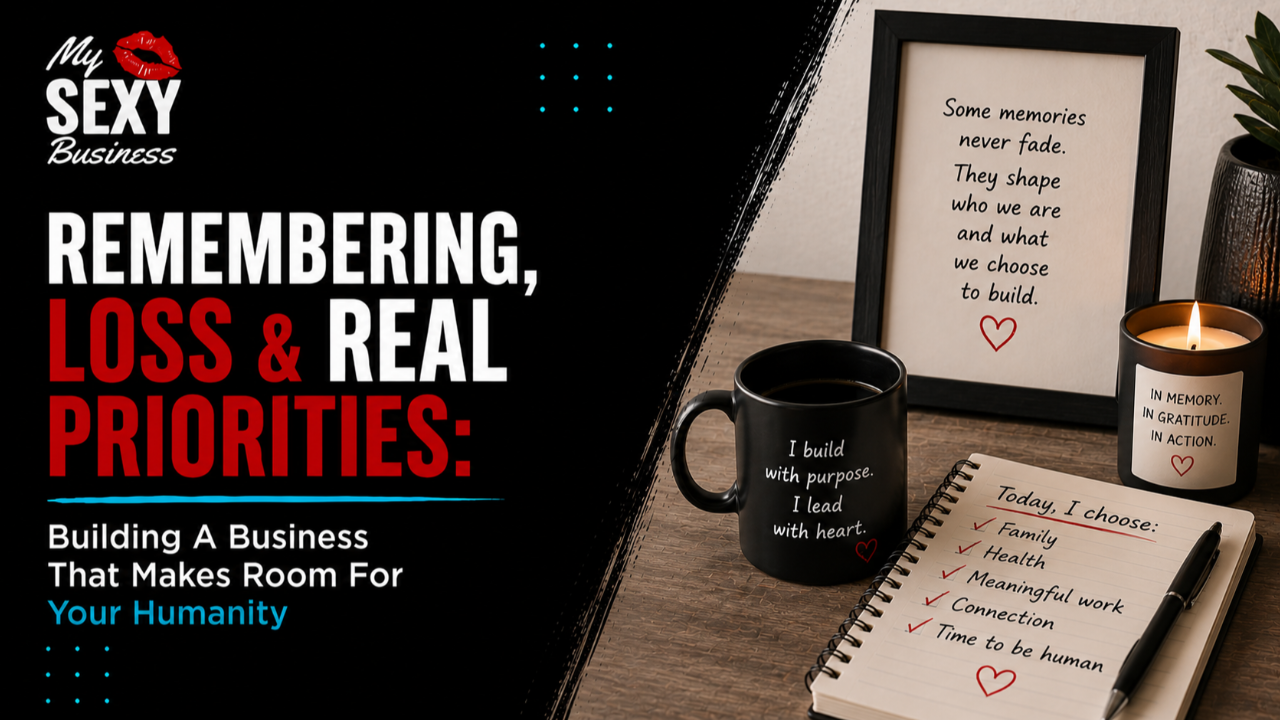
There are days when “business as usual” doesn’t feel possible.
You still have clients, deadlines, emails, and bills.
But your heart is sitting somewhere else entirely.
Maybe it’s an anniversary, a birthday, or a date like September 11.
Maybe it’s the day everything changed for your family.
Maybe it’s a quieter kind of marker that only you really notice.
On those days, you might find yourself wondering:
How do I live with loss and still build a business?
Is it okay to slow down when everyone else seems to be speeding up?
Do I have to choose between honoring what I’m feeling and showing up for my work?
In a recent Buckets and Boom Gates episode, Jill and Kim unpacked how remembrance, grief, and real priorities can coexist with entrepreneurship. This post pulls from that conversation and offers a gentle framework for navigating those tender days.
___________________________________________________________________________________________________
What Remembering Really Is (And What It Isn’t)
We often treat remembering as simply “thinking back” or recalling facts.
But in the episode, Jill and Kim offered a deeper definition:
- Remembering is the act of intentionally bringing a person, moment, or experience back into your awareness so it continues to matter in the present. It’s more than recalling a fact; it’s choosing to honor what has shaped you by reflecting on it, learning from it, and letting it influence how you live, lead, and relate today.
That kind of remembering isn’t about living in the past. It’s about acknowledging that certain people and events have permanently shaped who you are.
Remembering says:
“This mattered.
It still matters.
And it will keep shaping how I move through the world.”
On days like September 11, that remembering is also communal:
- September 11 is a day of remembrance and reflection, honoring the lives lost, the families forever changed, and the courage of those who stepped forward to help. It invites us to pause, acknowledge the weight of that day, and choose to move forward with more compassion, unity, and care for one another.
Remembering in this sense is not a distraction from life or business. It’s a recalibration.
___________________________________________________________________________________________________
The Collision Between Loss and Business
Life doesn’t ask your business for permission before something big happens.
Loss shows up in your world and your workload at the same time:
- A death in the family
- Illness or diagnosis
- Divorce or relationship shifts
- A child who needs more of you
- A parent who suddenly needs care
- Global or national events that stir up old or new wounds
Your inbox does not magically clear itself when your heart is heavy.
Your calendar does not automatically rearrange itself around grief or remembrance.
So you end up trying to carry:
- The emotional weight of what you’re remembering
- The logistical weight of your responsibilities
This is where the questions kick in:
- “Am I being unprofessional if I slow down?”
- “Am I being unrealistic if I try to keep going like nothing’s happening?”
- “What does it even mean to ‘show up’ on a day like today?”
The answer is not to split yourself into two separate people—one who feels and one who works. That’s a recipe for burnout and numbness.
Instead, the invitation is to let remembrance and real life sit in the same chair.
___________________________________________________________________________________________________
Moving On vs Moving Forward
One of the most helpful distinctions from the episode is this:
Moving on and moving forward are not the same thing.
“Moving on” often sounds like:
- “Get over it.”
- “Stop thinking about it.”
- “Leave that behind and act like everything is normal.”
For many experiences, especially deep loss, that’s neither realistic nor kind.
“Moving forward” acknowledges:
- This happened.
- It changed me.
- I am still here.
- I will keep going, with this as part of my story.
Moving forward doesn’t ask you to forget. It asks you to keep walking with what you remember.
On days of remembrance, moving forward might simply mean:
- Lighting a candle
- Saying a name out loud
- Sitting in silence for a few minutes
- Letting yourself cry
- Rescheduling something that can wait
- Doing only the most essential work
You are not “weak” or “behind” for needing that. You are human.
___________________________________________________________________________________________________
How Loss Clarifies What Actually Matters
Loss has a brutal way of clarifying priorities.
It exposes how flimsy some of our “urgent” tasks really are.
It asks hard questions like:
- If life is this fragile, what am I really doing with my time?
- Why am I saying yes to things that don’t line up with what I value?
- What truly matters right now?
In the episode, Jill and Kim offered this working definition:
- Focusing on the real priorities means putting your time, energy, and attention on the few things that truly move the needle, instead of getting lost in distractions, busywork, or other people’s urgencies. It’s the practice of regularly stepping back to ask, “What actually matters most right now?” and then aligning your schedule, decisions, and actions with those answers, even when it means saying no to good but less important things.
On a normal workday, “real priorities” might look like:
- Revenue‑generating tasks
- Deep client work
- Key systems and structure
- Your core relationships
- Your own health
On a day of remembrance or fresh grief, real priorities might shift:
- Taking care of your basic needs
- Being present with loved ones
- Doing only the most essential tasks in your business
- Honoring what or who you’re remembering
Your priorities are allowed to flex around real life. That doesn’t make you uncommitted. It makes you honest.
___________________________________________________________________________________________________
Three Anchors For Tender Days
Jill and Kim suggested three practical anchors you can use when remembrance and business collide:
1. Adjust, don’t abandon
2. Presence over performance
3. One small act of remembrance, one small act of aligned work
1. Adjust, Don’t Abandon
You may not be able to operate at your usual pace or capacity. That doesn’t mean you have to throw your business away or ghost your commitments.
Adjustment might look like:
- Rescheduling non‑essential calls
- Shortening episodes or posts
- Doing low‑bandwidth tasks and leaving heavy creative work for later
- Focusing only on serving current clients well
You’re not quitting. You’re adjusting to match your current capacity.
2. Presence Over Performance
On hard days, trying to force your “high‑energy, everything is fine” self can feel false and exhausting.
Instead, aim for honest presence:
- Show up in a quieter, more grounded way
- Be transparent (in a measured way) about being in a tender season
- Skip the extra flair and focus on core value
People can feel the difference between a mask and a more subdued but real version of you.
You don’t have to entertain. You can just be present.
3. One Small Act of Remembrance, One Small Act of Aligned Work
To avoid both extremes (checking out completely or overcompensating), the episode encourages you to choose:
- One act of remembrance
- One act of aligned work
Examples of an act of remembrance:
- Lighting a candle
- Visiting a place
- Writing a memory
- Sending a message to someone who also remembers
Examples of an act of aligned work:
- Completing one important task (not ten small distractions)
- Checking in with a key client
- Looking at your calendar and removing one non‑essential thing
- Working on a priority project for 20–30 focused minutes
Just one of each. That’s enough for today.
___________________________________________________________________________________________________
A Simple Reflection Practice For Days of Remembrance
If you’re not sure where to start on a day that feels heavy, here is a gentle practice you can try:
1. Take five minutes of quiet.
- Put your phone away. Sit somewhere still.
2. Ask yourself two questions:
- What am I remembering today?
- What actually matters most right now?
Let your answers be honest. They might be about a person, a value, a promise, or simply “I’m tired and I need rest.”
3. Choose one small way to honor what you’re remembering.
- It does not have to be public or elaborate. Small counts.
4. Choose one small next step in your business that aligns with what truly matters.
- It might be doing less, not more.
5. Let that be enough.
- You can always do more later. Today, you anchored both your humanity and your work in what is real.
___________________________________________________________________________________________________
You Don’t Have To Split Yourself In Two
You are not two different people—a grieving person over here and a business owner over there.
You are one whole human, living in a real world where loss, remembrance, responsibility, and calling all exist side by side.
Building a business that can flex around your humanity is not a luxury. It is a form of wisdom.
Remembering does not mean you’ve “stayed stuck.”
Adjusting does not mean you’re “less committed.”
Slowing down on hard days does not mean you’re “falling behind.”
It means you are paying attention to what actually matters.
As Jill and Kim said in the episode, you can hold remembrance, loss, and business in the same pair of hands—without pretending that one cancels out the other.
You are allowed to build something beautiful and true,
even with a tender heart,
even with memories that still ache,
even on days when the numbers on your screen are not the most important numbers you’re holding.
You don’t have to leave your grief at the door to be “professional.”
You get to bring your whole self—and, in doing so, you may actually build something deeper, kinder, and more aligned than you ever would have otherwise.
If you missed the conversation between Kim and Jill on their podcast Buckets and Boom Gates, you can listen to Episode #129 here
Looking for a Community?
We believe business is better together!
The My Sexy Business Community has many facets so we encourage you to explore the different creative solutions we offer for business owners and entrepreneurs ... like support, accountability, strategy, and so much more. We hope to see you on the inside! Click here to join us.
To connect and find out more about Kim or how to create a sexy business for a sexy life, you can reach her and the My Sexy Business Team at www.mysexybusiness.com.
And to connect with Jill Olish go straight to her website www.mamaoutspoken.com and you’ll find her there!
Our one & only choice for us & all our clients to build our online brands and presence is this all-in-one platform!
And our favorite for streaming live is this!
Blog #182
