
Feedback That Builds vs. Feedback That Breaks: How to Protect Your Confidence and Still Grow
Oct 07, 2026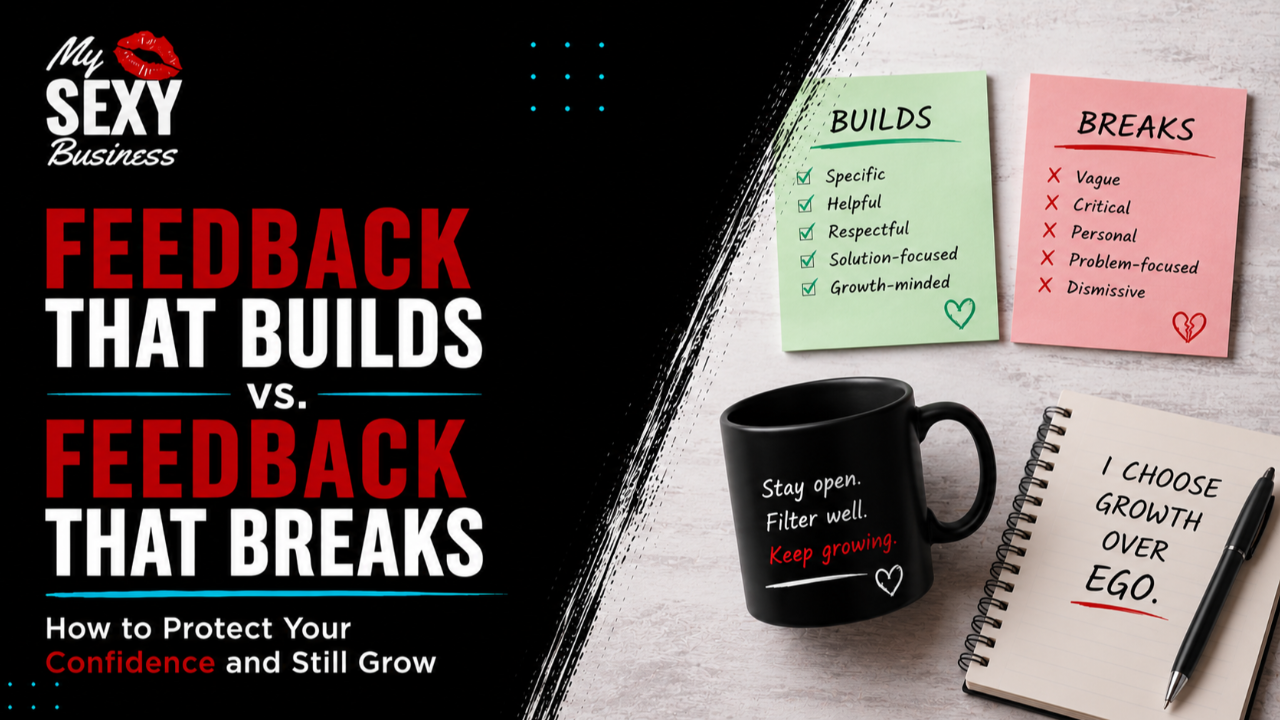
If you’re building a business, creating content, or leading anything, you’re going to get feedback.
Some of it will help you grow faster than you ever could on your own.
Some of it will make you want to quit, hide, or never post again.
And a lot of it will be confusing.
Was that helpful honesty… or unnecessary harshness?
Am I being defensive… or is this just not for my good?
Do I need thicker skin… or better boundaries?
In a recent Buckets and Boom Gates episode, Jill and Kim unpacked the difference between feedback that builds you and feedback that quietly breaks you down. This post pulls out the key ideas so you can hold onto your confidence and keep growing.
___________________________________________________________________________________________________
Is Feedback Really A Gift?
You’ve probably heard the phrase, “Feedback is a gift.”
Sometimes, that’s true. Sometimes, people say it right before they hit you with something that feels more like a punch than a present.
So let’s start with a clear definition of healthy feedback:
Feedback is a gift means that honest, thoughtful input from others is something valuable you receive, not an attack to defend against. Even when it’s uncomfortable, good feedback gives you insight you can’t get on your own, helping you see blind spots, improve your work, and grow faster than you would without it.
Healthy feedback is:
- Oriented toward your growth
- Thoughtful about timing and tone
- Specific enough to be useful
- Anchored in respect for you as a person
Unhealthy feedback might still be “honest” in the sense that it’s what someone thinks. But it often comes without care, consent, or context.
Healthy feedback says:
“I’m for you. Here’s something that might help.”
Unhealthy feedback says:
“I needed to say this. What you do with it isn’t my concern.”
___________________________________________________________________________________________________
Timing Matters More Than We Think
You can say almost anything in a way that helps or hurts depending on *when* you say it.
There’s a big difference between:
- A mentor giving you notes on your talk a month before you deliver it
- Someone pointing out everything they didn’t like right before you go on stage
- A stranger critiquing your performance in the comments five minutes after you share something vulnerable
That last one? That’s giving your opinion at a time that doesn’t benefit the receiver.
Examples:
- Tearing apart someone’s webinar structure while they’re still live and can’t process it
- Critiquing a first‑time speaker in the hallway immediately after they step off stage, when they’re shaky and raw
- DMing a list of “shoulds” right after someone shares something tender or personal
Even if your points are valid, the timing can turn potential coaching into emotional shrapnel.
Helpful feedback asks:
- “Are they in a place to hear this right now?”
- “Is this the moment they need critique—or care?”
___________________________________________________________________________________________________
What Is Red Carpet Feedback?
Jill and Kim use a vivid phrase for a certain kind of unhelpful feedback: red carpet feedback.
Red carpet feedback is actually about the giver, not the receiver. It often shows up at bad timing and is unkind. It doesn’t genuinely help them and can even hold them back by creating insecurities and fears. It causes confidence to leak and escalates feelings of vulnerability.
Think of red carpet feedback like this:
The person giving it is rolling out a red carpet for themselves.
- They want to appear extra insightful, bold, or “real”
- They center their opinion over your experience
- They’re more focused on being heard than on you being helped
Red carpet feedback often sounds like:
- “Someone had to say it.”
- “I’m just being honest.”
- “You needed to hear this.”
But there’s no real care for:
- Where you are emotionally
- What you actually need
- Whether you have capacity to use this feedback well
If you’ve ever shared something you were proud of and walked away from “feedback” feeling smaller, more uncertain, or weirdly afraid to try again… you’ve probably been on the receiving end of red carpet feedback.
___________________________________________________________________________________________________
How To Tell If Feedback Is For You (Or For Them)
When feedback comes in, you don’t have to automatically swallow it whole. You can pause and run it through a few simple filters.
Ask yourself:
1. Did I ask for this?
Invited feedback (from a coach, peer, or trusted friend) is one thing.
Uninvited feedback from a stranger or distant acquaintance is another.
That doesn’t mean uninvited feedback is always wrong.
But it does change how quickly—and how deeply—you let it in.
2. Does this person understand what I’m trying to build?
Do they:
- Know your audience?
- Know your values?
- Know your goals?
If someone doesn’t understand the game you’re playing, their feedback might judge you by rules you don’t actually live by.
3. Is it specific and actionable, or vague and judgmental?
“This part of your sales page confused me; I wasn’t sure what the outcome was”
is very different from
“This whole thing just feels off.”
Specific feedback gives you a handle.
Vague judgment just weighs you down.
4. How does my body respond?
You might feel an initial sting with helpful feedback. That’s normal when you care.
But useful feedback, even when hard, often lands with a sense of:
“That’s uncomfortable… but I can see how that’s true or helpful.”
Red carpet feedback tends to feel like:
- The floor drops out
- Shame floods in
- You feel smaller, not stronger
Your body’s response is not *everything*, but it’s data.
___________________________________________________________________________________________________
How To Receive Feedback Without Crumbling
Even healthy feedback can be hard to hear. Here are a few ways to take it in without losing yourself.
Create a little space
Instead of reacting immediately, try:
“Thank you for sharing that. I’m going to sit with it.”
This buys you time and lets your nervous system calm down.
Later, you can decide:
- What you’ll keep
- What you’ll examine
- What you’ll set down
Separate your work from your worth
Your offer, post, talk, or service is something you created, not who you are.
If someone says:
“This email was confusing,”
it does *not* mean:
“You are confusing as a human.”
The more you remind yourself of this, the easier it is to edit, refine, and grow without taking every suggestion as a personal attack.
Bring a second set of eyes
If feedback hits hard, share it with someone you trust:
“Here’s what was said. Does this match what you see? Is there something I need to look at here?”
Let a trusted voice help you sift:
- “Yes, there’s a good point inside this rough delivery.”
- “No, this feels more like their stuff than yours.”
You don’t have to decide alone.
___________________________________________________________________________________________________
How To Give Feedback Without Breaking People
We’re all on both sides of this.
At some point, you will be the one giving feedback—to team members, peers, clients, speakers, creators.
A few simple principles can help:
1. Get consent
Instead of launching into your thoughts, ask:
“Are you open to some feedback on this?”
or
“I have a thought that might help—would you like to hear it?”
If they say “not right now,” honor that.
You can offer again later—or not at all.
2. Check your motive
Quietly ask yourself:
“Am I saying this to serve them… or to show off / vent / feel superior?”
If your motive is mostly about:
- Proving you’re right
- Being the smart one
- Getting something off your chest
…you might want to press pause.
3. Consider timing
Are they:
- About to go live?
- Fresh off stage?
- In the middle of a big, fragile moment?
That might not be the moment to unload every critique.
You can say:
“I’m really proud of you for doing that. When you’re ready, I have a couple of thoughts that might help strengthen it—want to hear them later?”
4. Be kind and specific
Start with what’s working:
“I loved how you explained X—it was really clear.”
Then offer something concrete:
“One spot that felt a little confusing to me was here. Maybe you could add a simple sentence that connects A to B.”
You’re building, not bulldozing.
___________________________________________________________________________________________________
Setting Boundaries With Red Carpet Feedback
You are allowed to decide who gets to speak deeply into your work and who doesn’t.
If you notice a person consistently:
- Dropping unasked, harsh opinions
- Critiquing with no context or care
- Always finding what’s wrong first
…it’s okay to:
- Share less behind‑the‑scenes with them
- Change the subject
- Use a simple boundary phrase
Examples:
“I’m not looking for feedback on this right now, but thank you.”
or
“I’m already working with someone on this, so I’m not taking additional feedback at the moment.”
You don’t have to debate or defend.
You’re just closing a door that was never meant to stay wide open.
Your confidence is not a community project. You get to protect it.
___________________________________________________________________________________________________
Two Simple Steps To Practice This Week
To bring all of this down to earth, here are two small actions you can take this week.
1. Ask for one piece of helpful feedback on purpose
Pick:
- One area where you’d genuinely like to improve
- One trusted person who knows your heart and your work
Ask them something specific like:
“Would you be willing to look at this and share one thing that’s working well and one thing that could be clearer?”
This trains your nervous system to experience feedback as something *invited and useful*, not always random and wounding.
2. Decide how you’ll respond to unhelpful feedback
Before it shows up, write down one sentence you’ll use when red carpet feedback arrives.
For example:
“Thanks for sharing your perspective. I’m not receiving feedback on this right now.”
or
“I appreciate you caring enough to say something. I’m not in a place to process feedback on this yet.”
Practice it once or twice out loud so it’s there when you need it.
___________________________________________________________________________________________________
You’re Allowed To Grow And Be Protected
Here’s the heart of it:
You are allowed to be someone who grows and someone who is guarded.
You do not have to choose between:
- Being open to feedback
- And being constantly knocked down by every opinion
Healthy feedback stretches you, but it does not strip you.
Red carpet feedback shrinks you, and you are not required to carry it.
You can:
- Invite wise voices to speak into your work
- Thank people for thoughtful input
- Let your work get better and better over time
And you can also:
- Decline feedback that is poorly timed, unkind, or clearly not for your good
- Protect your confidence so you can keep showing up
- Be the kind of person who gives feedback with care, not with a spotlight on yourself
You do not have to be perfect to be valuable.
You are allowed to be a work in progress with boundaries.
And that, more than anything, is what will let you keep creating the work only you can do.
If you missed the conversation between Kim and Jill on their podcast Buckets and Boom Gates, you can listen to Episode #134 here
Looking for a Community?
We believe business is better together!
The My Sexy Business Community has many facets so we encourage you to explore the different creative solutions we offer for business owners and entrepreneurs ... like support, accountability, strategy, and so much more. We hope to see you on the inside! Click here to join us.
To connect and find out more about Kim or how to create a sexy business for a sexy life, you can reach her and the My Sexy Business Team at www.mysexybusiness.com.
And to connect with Jill Olish go straight to her website www.mamaoutspoken.com and you’ll find her there!
Our one & only choice for us & all our clients to build our online brands and presence is this all-in-one platform!
And our favorite for streaming live is this!
Blog #192
