
When Big Projects Break Your Brain: Colossal Effort, Overwhelm, and Majoring on the Minors
Sep 30, 2026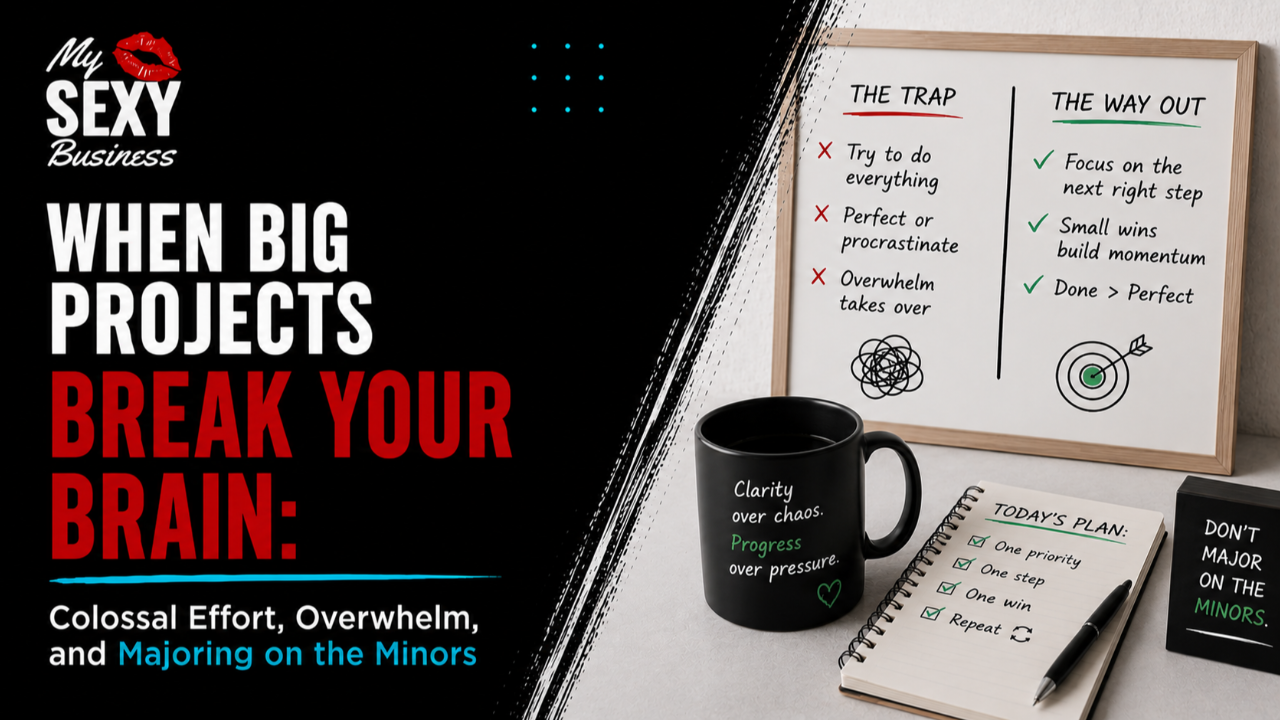
You pour yourself into a launch.
You host a big event.
You finally finish building that course, writing that book, delivering that massive client project.
You hit send. You close the browser tab. You walk out of the room.
This was the thing you circled on your calendar.
The thing you told yourself, “When I get through this, I’ll feel amazing.”
And then…
You don’t.
Instead of feeling victorious, you feel:
- Weirdly flat
- Extra emotional
- Irritated by tiny things
- Unsure what to do next
- Overwhelmed by all the “little stuff” you suddenly want to fix
If that’s familiar, there is nothing wrong with you. You’re just experiencing what happens after something colossal.
In a Buckets and Boom Gates episode, Jill and Kim unpacked why this happens and how to handle it without spiraling. This post breaks down the key ideas: what “colossal” really is, why your brain crashes afterward, and how to stop majoring on the minors when you’re already spent.
___________________________________________________________________________________________________
What Makes A Project “Colossal”?
Colossal describes something extremely large in size, impact, or importance. It goes far beyond ordinary or big, suggesting a scale that feels massive, impressive, or overwhelming.
A project can be colossal because:
- It’s big on the outside: a major launch, a multi‑day event, a long build.
- It’s big on the inside: emotionally loaded, personally meaningful, or financially crucial.
- It’s your first time doing something at this scale.
From the outside, people might say, “Oh, cool, you did a webinar.”
From the inside, it feels like:
- Weeks of prep
- Late‑night decisions
- Stretching your skills
- Carrying other people’s expectations
- Wrestling with your own fears
Colossal projects tend to pull your life into “push mode.”
You tell yourself:
“I’ll rest when this is over.”
“I’ll answer those texts later.”
“I’ll clean up my space after this is done.”
“I just need to get through this.”
Sometimes, for a short season, that kind of focused push is necessary. The trouble starts when we don’t understand what happens after the push.
___________________________________________________________________________________________________
Why You Feel Overwhelmed After You Finish
Let’s name the question directly:
Why do I feel overwhelmed after I finish a project?
A few reasons:
1. You’ve Been Running On Adrenaline
During a big push, your nervous system goes into “game mode.”
You’re on high alert. Focused. Compressed.
When the project ends, the adrenaline drops.
That drop can feel like:
- Exhaustion
- Sadness
- Anxiety
- A sense of “crashing”
Nothing is “wrong” with you. Your body is coming down from an extended high‑intensity state.
2. Your Clear Scoreboard Disappears
During a colossal project, you have a simple scoreboard:
- Finish the slides
- Send the emails
- Show up at this time
- Hit this deadline
Afterward, that clarity is gone.
Your brain suddenly has to decide, “What matters now?”
Without a clear answer, it starts scanning for anything it can control.
3. Your Expectations Don’t Match Reality
We quietly hope that finishing the big thing will fix our feelings:
- “When I finish this, I’ll feel proud and peaceful.”
- “When this is over, I’ll feel secure.”
- “When I get through this, I’ll finally be able to relax.”
Sometimes results align with that. Often, they don’t perfectly match the movie in our head.
If the numbers aren’t what you hoped, or even if they are but you still feel tired and empty, disappointment stacks on top of fatigue.
Put all three together and of course you feel overwhelmed.
You just carried something colossal. Your system is trying to recalibrate. It’s not malfunctioning—it’s responding.
___________________________________________________________________________________________________
Majoring On The Minors: Why You Suddenly Obsess Over Tiny Things
Here’s where another pattern shows up after big projects: majoring on the minors.
Majoring on the minors means spending most of your time and energy on small details or low‑impact tasks while neglecting the big, important things that actually drive results. It’s getting deeply focused on what’s comfortable or easy to control instead of what truly matters.
After a huge push, you might find yourself:
- Tweaking fonts for two hours
- Re‑organizing folders while ignoring rest or follow‑up
- Checking your stats every five minutes
- Fixating on tiny design changes
Why?
Because:
- The big decisions are done (for now) and your brain hates feeling idle
- High‑stakes choices drained you, so you reach for low‑stakes control
- You want to feel productive without having to face the deeper exhaustion or next round of risk
Your brain thinks:
“I can’t control who buys.
I can’t control what people say.
But I can control this color, this layout, this folder structure.”
A little bit of that can be fine. The problem comes when those tiny tasks become your main focus and you still feel like you’re drowning.
Now you’re exhausted from both the colossal project *and* the swirl of meaningless busywork.
___________________________________________________________________________________________________
Three R’s For Life After A Colossal Push: Recover, Review, Refocus
Jill and Kim suggest a simple three‑part framework for landing the plane after a big project:
1. Recover
2. Review
3. Refocus
1. Recover
Recovery is not optional. It is part of the project.
You planned the build‑up; you also need to plan the come‑down.
Recovery might look like:
- A lighter workday (or a day off) right after you finish
- More sleep and actual, nourishing meals
- Time outside and gentle movement
- Conversations with safe people who aren’t asking you for anything
If you don’t intentionally recover, your brain will try to force a recovery in more chaotic ways—through burnout, shutdown, or overreactions to small things.
Treat recovery as a non‑negotiable phase, not a guilty indulgence.
2. Review
Once the initial crash has eased a bit, it’s time to review—not to punish yourself, but to learn.
Ask:
- What was I trying to do with this project?
- What actually happened? (numbers, experiences, responses)
- What went well that I want to repeat?
- What was harder than expected?
- What did I learn about myself, my audience, my offer?
Notice that none of those questions is “Why am I such a failure?”
That’s armchair‑quarterbacking energy (harsh hindsight criticism).
Review is different. It’s athlete‑energy: “Let’s watch the tape and adjust.”
You’re looking at the game, not attacking the player.
3. Refocus
After you’ve recovered a bit and taken an honest look at what happened, it’s time to refocus on what actually matters next.
This is where you gently stop majoring on the minors.
Ask:
- What are the top one to three priorities that truly matter in this next stretch?
- Given my current capacity, what’s the next right move in one of those areas?
Real priorities might be:
- Serving existing clients well
- Following up with warm leads from the project
- Improving one key system that will make future projects easier
- Creating a more sustainable schedule
When you catch yourself obsessing over low‑impact tasks, use this filter:
“If I only had one solid hour of energy this week, is this where I’d spend it?”
If the answer is no, it’s a minor.
___________________________________________________________________________________________________
Two Simple Practices For Your Next Big Finish
Here are two small, practical practices you can try after your next colossal project (or even now, if you’re still in the fog from the last one).
Practice 1: A 10‑Minute Decompression
Set a timer for 10 minutes.
No phone. No tasks. Just you and a pen/paper or notes app.
Ask:
- How do I actually feel right now? (physically and emotionally)
- What surprised me about how I feel now that this is done?
Write a few words or sentences. No fixing required.
Simply acknowledging your state is step one in recovery.
Practice 2: Majors vs. Minors List
Draw two columns on a page.
Label one “Majors” and the other “Minors”.
Under “Minors”, dump all the tiny tasks your brain is offering as “urgent”:
- Fix this button
- Clean this folder
- Change that word
- Refresh stats
- Tweak the header
Under “Majors”, list 3–5 truly important things for the next week or two:
- Client delivery
- Follow‑up conversations
- Key system or process improvements
- Rest and health
- A meaningful personal commitment
Then:
- Circle one Major for your next focused block of time.
- Give yourself permission to leave the Minors alone until that Major has gotten some love.
This one small act of prioritizing is how you begin to step out of the overwhelm and back into intentional leadership of your time and energy.
___________________________________________________________________________________________________
You’re Not Broken. You’re Coming Down From Colossal.
Feeling overwhelmed, flat, or off after a big project does not mean you’re weak, ungrateful, or “bad at business.”
It means:
- You carried something big
- Your nervous system did its best to help you get through it
- Now it needs recovery, context, and direction
You don’t have to fix everything right away.
You don’t have to chase every tiny improvement to justify your effort.
You don’t have to decide your entire future based on one set of results.
You do need to:
- Recover with some kindness
- Review with curiosity instead of contempt
- Refocus on what actually matters instead of drowning in the minors
The next time you finish something colossal and think, “Why do I feel like this?” remember:
Nothing is wrong with you.
You’re just in the landing phase.
Treat that phase with as much intention as you gave the takeoff, and you’ll be able to keep playing the long game without burning yourself out on every single flight.
If you missed the conversation between Kim and Jill on their podcast Buckets and Boom Gates, you can listen to Episode #133 here
Looking for a Community?
We believe business is better together!
The My Sexy Business Community has many facets so we encourage you to explore the different creative solutions we offer for business owners and entrepreneurs ... like support, accountability, strategy, and so much more. We hope to see you on the inside! Click here to join us.
To connect and find out more about Kim or how to create a sexy business for a sexy life, you can reach her and the My Sexy Business Team at www.mysexybusiness.com.
And to connect with Jill Olish go straight to her website www.mamaoutspoken.com and you’ll find her there!
Our one & only choice for us & all our clients to build our online brands and presence is this all-in-one platform!
And our favorite for streaming live is this!
Blog #190
