
You’re Not Failing, You’re In Training: Business Lessons From Sports
Sep 23, 2026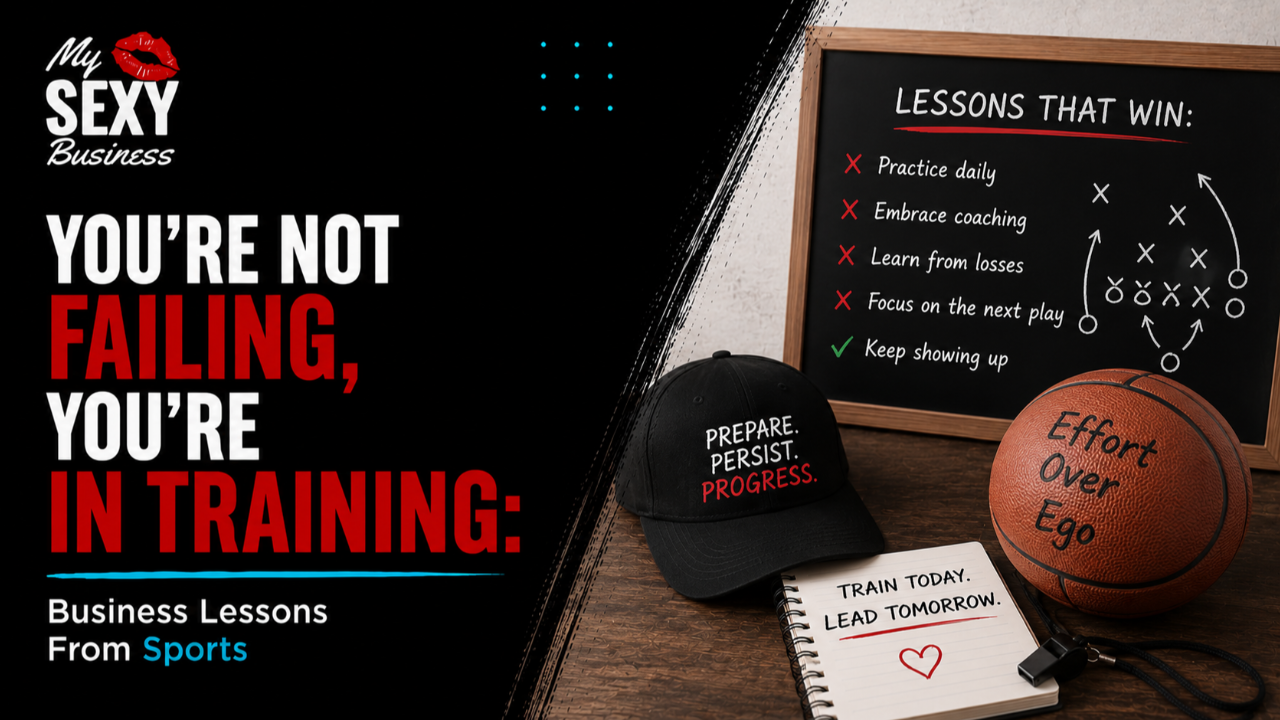
If you’ve been in business for any length of time, you’ve probably had at least one of these thoughts:
I should’ve known better.
I messed that up.
I’m terrible at this.
What was I thinking?
A launch underperforms.
A hire doesn’t work out.
A collaboration goes sideways.
An experiment flops.
And instead of seeing those moments as part of the game, you turn them into a referendum on your worth.
In a Buckets and Boom Gates episode titled Business as a Sport & Armchair Quarterbacking, Jill and Kim offered a different way to look at your business: not as a one‑shot test you either pass or fail, but as a sport you’re playing over seasons.
This post pulls out the key ideas from that conversation and shows you how to stop picking yourself apart from the stands and start playing to win on the field.
___________________________________________________________________________________________________
Seeing Business As A Sport
Most of us were trained to think in tests, not in seasons.
You take a test, you get a grade, and that grade says something about who you are.
Business doesn’t work like that.
A more helpful lens is this:
Seeing business as a sport means treating it like an ongoing game where you train, practice, compete, learn from losses, and aim to improve your performance over time. You track the score with metrics, build a strong team, study your playbook and your opponents, and focus on discipline, resilience, and consistent reps rather than expecting instant wins.
In a sport, you expect:
- Training sessions and practice drills
- Games you win and games you lose
- Off‑seasons and on‑seasons
- Injuries, recoveries, and comebacks
- Coaches, teammates, and support staff
- A scoreboard—but not every game is a championship
In business, that translates to:
- Skill‑building and experimentation
- Offers that land and offers that don’t
- Periods of visibility and periods of rebuilding
- Launches that soar and launches that sting
- Mentors, peers, and communities
- Metrics that matter—but don’t define your entire career
The key shift is this:
You are not taking one big test.
You are playing a long game.
___________________________________________________________________________________________________
On The Field vs. In The Stands
In sports, there are two very different perspectives:
1. On the field
2. In the stands
On the field, you are:
- Making decisions in real time
- Feeling the pressure of the clock and the crowd
- Dealing with hits, fatigue, and unexpected plays
- Operating with incomplete information
In the stands, you:
- See the whole field
- Have replays and slow‑motion
- Can pause, rewind, and analyze
- Aren’t the one getting hit
It’s easy to say, “They should have done this instead,” from a seat where you’re not carrying the responsibility or risk.
The same thing happens in business.
On the field of your business, you make calls while juggling:
- Finances
- Family
- Health
- Team dynamics
- Client expectations
- Your own emotional world
From the stands, it’s easy for someone else to say:
- That price was wrong
- You should have seen that coming
- I would have done it differently
The problem is not that people have opinions—that’s inevitable. The real problem is when you start talking to yourself like a fan in the stands instead of a player on the field.
___________________________________________________________________________________________________
What Is Armchair Quarterbacking?
Jill and Kim used a helpful phrase to describe this harsh hindsight:
Armchair quarterbacking is criticizing or second-guessing decisions from a safe distance, after the fact, without having carried the responsibility, pressure, or real-time constraints of the person who actually had to make the call. It’s easy, hindsight-based judgment that often overlooks context and complexity.
We usually think of armchair quarterbacking as something sports fans do to players and coaches.
But more often than not, the loudest armchair quarterback in your business is… you.
You watch the replay of your decisions and say things like:
- I should have known this wouldn’t work
- I never should have trusted that person
- I’m just bad at [hiring, launching, selling, etc.
- Clearly I’m not cut out for this
You’re judging past‑you with today’s information and calm perspective, forgetting that past‑you was under very different conditions and pressure.
Armchair quarterbacking doesn’t make you better. It just makes you scared to touch the ball again.
___________________________________________________________________________________________________
Reviewing The Tape Like A Coach, Not A Critic
Athletes don’t get better by beating themselves up. They get better by reviewing the tape with a coach’s mindset.
After a game, a good coach doesn’t sit the team down and say, “You’re all terrible, what were you thinking?”
They say, “Let’s see what happened. Let’s find what went well and where we can improve.”
You can do the same in your business.
After a launch, a hire, a project, or a decision, ask:
1. What was I trying to do?
- Grow my audience? Test a new offer? Free up my time?
2. What information did I have at the time?
- What did I know—and *not* know—when I made this decision?
3. What actually happened?
- What were the numbers, responses, patterns?
4. What went well?
- What should I keep or repeat next time?
5. What didn’t work the way I hoped?
- Where did things break down?
6. What will I try differently next time?
- One or two specific adjustments, not a total teardown
The tone here is everything.
Coach energy says:
- You did your best with what you had
- Now let’s pull the lesson out and get back to training
Critic energy says:
- You’re an idiot
- How could you not have seen this?
- Maybe you should quit.
Same event. Two very different internal realities.
___________________________________________________________________________________________________
Playing To Win: Training, Reps, and Seasons
If you’re going to treat business like a sport, you need three elements:
1. Training
2. Reps
3. Seasons
1. Training
You wouldn’t expect to run a marathon without training. But many business owners expect to nail sales calls, content, launches, and leadership on the first try.
Training might look like:
- Practicing your pitch with a friend
- Role‑playing common objections
- Studying how others structure their offers
- Taking courses or coaching and actually implementing
You’re not “bad” if this doesn’t come naturally. You’re just in training.
2. Reps
One attempt isn’t enough to judge your skill.
Reps look like:
- Making offers consistently, not just once a quarter
- Writing regularly instead of once in a blue moon
- Hosting several lives/webinars to find your rhythm
- Sending multiple emails, not one lone announcement
A rep can be as simple as:
- One clear offer a day for 5 days
- Writing for 20 minutes three times a week
- Reaching out to one warm lead each workday
You’re building muscle, not trying to impress the judges.
3. Seasons
You cannot be in launch mode 365 days a year.
Just like athletes have:
- Pre‑season
- In‑season
- Post‑season
- Off‑season
Your business needs:
- Build seasons (creating assets, offers, systems)
- Push seasons (launching, selling, visibility)
- Recovery seasons (rest, reflection, consolidation)
If you judge yourself only by your “stats” in a recovery season, you’ll think you’re failing. But from a sports lens, you’re actually doing the necessary work to stay in the game long‑term.
___________________________________________________________________________________________________
Stop Picking Yourself Apart, Start Playing To Win
Picking yourself apart looks like:
- Constantly replaying past decisions with shame
- Using every imperfect outcome as proof you’re not good enough
- Demanding instant mastery in areas you’ve barely practiced
Playing to win looks like:
- Owning your role as a player on the field
- Expecting mistakes and learning from them
- Committing to reps, not perfection
- Tracking the score, but not making every game a verdict on your identity
You can absolutely take responsibility for your choices.
You can absolutely refine your skills.
You can absolutely raise your standards.
You just don’t have to destroy yourself in the process.
___________________________________________________________________________________________________
A Simple Weekly Rhythm: Practice and Review
Here’s a simple rhythm Jill and Kim suggest to bring this sports mindset into your week.
Step 1: Choose One Skill To Practice This Week
Pick one area:
- Making offers
- Sales calls
- Writing content
- Delegating
- Time boundaries
Define what “reps” look like.
Examples:
- 1 offer per day for 5 days
- 3 short videos this week
- 20 minutes writing, 3 times this week
- Ending work at your planned stop time every day
Write it down. This is your training plan for the week.
Step 2: Schedule A 10–15 Minute Review
At the end of the week, block 10–15 minutes.
Ask yourself:
- What did I actually do?
- What went well or felt good, even in a small way?
- What did I learn, and what’s one adjustment I’ll try next week?
No spirals. No character assassination.
Just like a coach watching game tape:
- Celebrate wins
- Note breakdowns
- Plan the next round of practice
___________________________________________________________________________________________________
You Are Not Just A Critic; You Are A Player
The biggest shift of all is identity.
You are not just the commentator.
You are not just the critic in your own head.
You are a player. You are in the arena.
Players:
- Get dirty
- Get tired
- Get it wrong sometimes
- Learn
- Get back up
- Play again
You don’t have to wait to feel perfectly confident to start playing this way. You can decide today to:
- Talk to yourself like a coach, not a troll
- See your business in seasons, not single tests
- Commit to reps instead of chasing instant mastery
- Review with curiosity instead of shame
You’ll still make mistakes. You’ll still have losses.
But you’ll be playing to win, not sitting in the stands picking yourself apart.
And that is how you build something that lasts.
If you missed the conversation between Kim and Jill on their podcast Buckets and Boom Gates, you can listen to Episode #132 here
Looking for a Community?
We believe business is better together!
The My Sexy Business Community has many facets so we encourage you to explore the different creative solutions we offer for business owners and entrepreneurs ... like support, accountability, strategy, and so much more. We hope to see you on the inside! Click here to join us.
To connect and find out more about Kim or how to create a sexy business for a sexy life, you can reach her and the My Sexy Business Team at www.mysexybusiness.com.
And to connect with Jill Olish go straight to her website www.mamaoutspoken.com and you’ll find her there!
Our one & only choice for us & all our clients to build our online brands and presence is this all-in-one platform!
And our favorite for streaming live is this!
Blog #188
