
Cultivating What Matters (And Why Your Focus Face Is Not A Problem)
Oct 14, 2026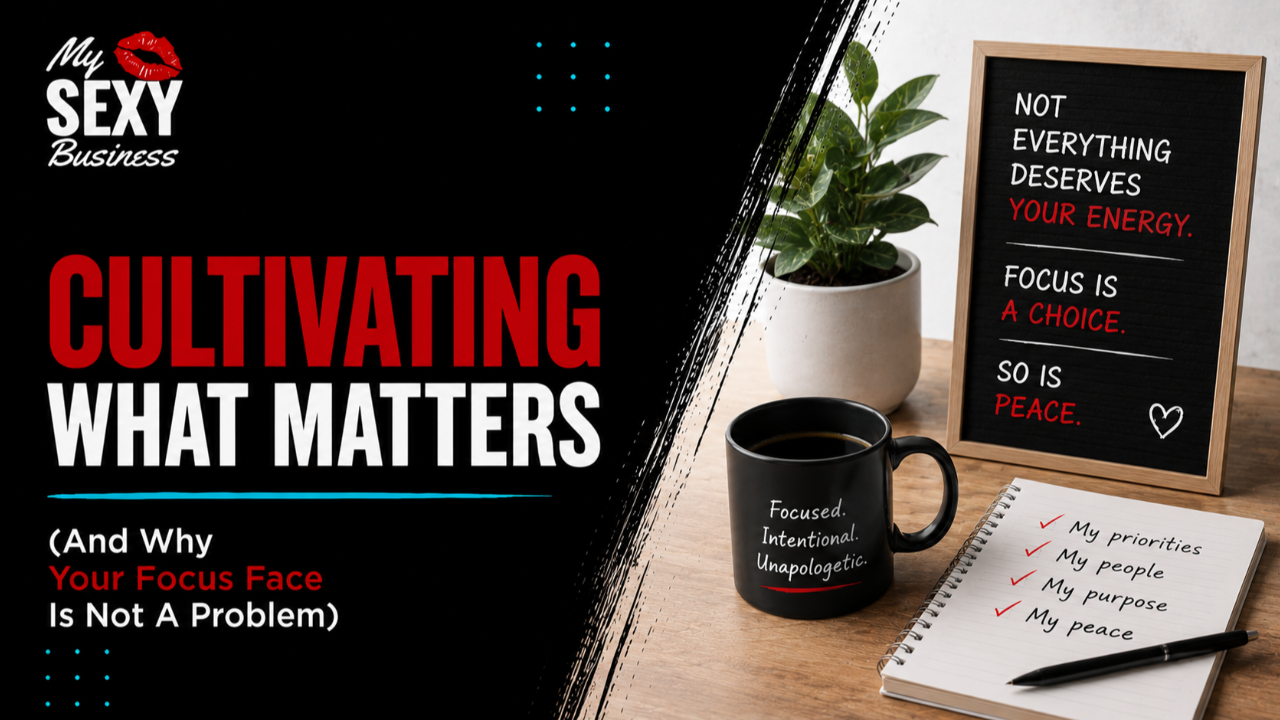
If you’ve been building a business or growing anything meaningful for a while, you’ve probably noticed two things:
1. The important stuff takes longer than you hoped.
2. You don’t always look “inspiring” while you’re doing the real work.
You might be in a long, quiet season of building—writing, planning, refining, serving—and feel like you don’t have much to “show.”
And when you do finally get on camera or in front of people, someone asks if you’re upset… just because your face looks serious while you’re thinking.
In a Buckets and Boom Gates episode, Jill and Kim unpacked two ideas that speak right into this:
- What it really means to cultivate in life and business
- Why your focus face is often a sign of deep engagement, not a flaw
This post pulls those ideas together so you can be kinder to your process and to yourself.
___________________________________________________________________________________________________
What Does It Mean To Cultivate?
We don’t use the word “cultivate” a lot in everyday conversation, but it’s a powerful lens for business and life.
Cultivate means to intentionally develop, nurture, and strengthen something over time through consistent care and attention. In life and business, it’s the slow, deliberate work of growing skills, relationships, ideas, or opportunities so they become healthy, strong, and fruitful, rather than expecting instant results.
Cultivating is different from:
- Chasing quick hacks
- Jumping from idea to idea
- Expecting overnight success after one big effort
Cultivating looks like:
- Writing every week, not just when you feel “inspired”
- Serving your current clients well, even when your audience is small
- Checking in on relationships over months and years
- Continuing to show up for your craft when the metrics are not impressive yet
It’s less fireworks and more crockpot.
The problem is that most of what we see online are highlight reels and “breakthrough” moments, not the years of cultivation that led up to them.
So it’s easy to believe:
- “I must be doing it wrong; it’s taking too long.”
- “If this were really meant to work, it would have popped by now.”
- “If I can’t show big results yet, maybe I shouldn’t talk about it.”
But cultivation *always* looks unimpressive in the middle.
Ask any gardener. There’s a long stretch where it’s just dirt and small shoots, and you’re out there watering anyway.
___________________________________________________________________________________________________
Where Cultivation Shows Up In Business
Cultivation isn’t just a mindset; it shows up in very concrete areas of your work.
1. Skills
Things like:
- Speaking
- Writing
- Coaching
- Selling
- Leading a team
These do not magically appear. You cultivate them.
That might mean:
- Practicing sales conversations, even when you still stumble
- Recording videos that never see the light of day, just to get more comfortable
- Taking notes after a call about what you’d say differently next time
Over time, this slow, repeated effort compounds.
2. Relationships
Your network, your clients, your collaborators—these are cultivated, not collected.
You cultivate relationships when you:
- Follow up with people even when there’s no immediate pitch
- Remember details about their life and check in
- Serve well enough that people naturally want to refer you
There’s no quick hack for trust. You earn it over time.
3. Offers & Ideas
Your offers (programs, services, products) almost never come out “perfect” on day one.
Cultivation here looks like:
- Testing a simple version
- Gathering feedback
- Refining the structure, messaging, and delivery
- Iterating instead of scrapping everything at the first hurdle
The most impactful offers are built, not downloaded fully formed.
___________________________________________________________________________________________________
Enter Focus Face
Now, let’s bring in the second idea that can mess with your head when you’re cultivating: focus face.
Focus face is the expression you unconsciously make when you’re deeply concentrating, often looking serious, intense, or even unfriendly, even though you’re simply absorbed in the task or conversation and not upset or disengaged.
You might recognize this in yourself if:
- People ask “Are you okay?” when you’re just thinking
- You watch a replay of a call and think, “Wow, I look mad,” even though you weren’t
- You become self‑conscious on camera and try to “fix your face” while still trying to articulate something complex
Focus face shows up:
- When you’re mapping out a big idea
- When you’re listening deeply to a client
- When you’re figuring out new tech
- When you’re planning long‑term strategy
In other words: focus face appears when you’re doing real work.
The trouble comes when:
- You interpret your own focused look as a problem
- Other people misread your seriousness as irritation, boredom, or judgment
- You start performing “friendly face” instead of allowing yourself to fully concentrate
Now you’re trying to cultivate *and* manage your appearance at the same time. That’s extra cognitive load you don’t need.
___________________________________________________________________________________________________
How Cultivation and Focus Face Intersect
Here’s how these two ideas tie together:
- Cultivation requires deep, sustained attention.
- Deep, sustained attention often produces focus face.
So if you’re committed to cultivating what matters in your business, you will have long stretches where you look serious. It’s part of the process.
The problem is that we’ve been sold a version of entrepreneurship where you’re supposed to:
- Always look energized
- Always look camera‑ready
- Always look light, polished, and charismatic
Even when you’re:
- Processing complex decisions
- Holding space for difficult client stories
- Wrestling with grief, change, or uncertainty while still showing up
That’s not realistic.
You’re allowed to look like you’re thinking when you’re thinking.
You’re allowed to look intense when you’re focused.
You’re allowed to be in “builder mode” without constantly smoothing your expression for imaginary critics.
___________________________________________________________________________________________________
Communicating About Your Focus Face
That said, communication can help.
Because while your focus face doesn’t mean anything is wrong, other people may misinterpret it if they don’t know you well.
You can head this off in small, simple ways.
With clients or team members
You might say:
- “If I ever look extra serious on a call, that usually means I’m really focusing or processing—not that I’m upset.”
- “Sometimes my ‘thinking face’ looks intense, but I’m actually very engaged. If you ever wonder, feel free to ask.”
This gives them a frame so they don’t fill the silence—or your face—with their own fears.
With your audience
On a live or recording, you could mention:
- “If my face goes into full focus mode for a second, it’s just because I’m trying to say this clearly. I’m good, I promise.”
It might feel a little silly to name it, but it can relax both you and the people watching.
___________________________________________________________________________________________________
Giving Yourself Permission To Look Like You’re Working
One of the quietest forms of self‑charity you can practice is allowing yourself to look like you’re actually working when you’re working.
That means:
- Not interrupting every deep thought to check how you look
- Not re‑recording every video because your eyebrows furrowed for a second
- Not assuming your serious expression equals “bad content”
Your value is not measured by how effortlessly cheerful you appear while solving hard problems.
Your clients and audience need your *attention* more than your constant smile.
You being fully present with them—listening, thinking, responding thoughtfully—is often far more impactful than you hitting a perfect “on‑brand” facial expression.
___________________________________________________________________________________________________
A Simple Two‑Part Practice For This Season
To bring this home, here’s a small practice you can use this week.
Part 1: Choose One Thing To Cultivate
Ask yourself:
“What is one thing I’m committed to cultivating over the next 30–90 days?”
It might be:
- Your email list
- A signature offer
- A key relationship
- Your speaking or writing skill
- Your own health or spiritual life
Write it down.
Then ask:
“What does slow, consistent care look like for this?”
Examples:
- One email per week
- One hour of offer development on Tuesdays
- A weekly check‑in message to a key connection
- Practicing speaking/writing three times a week for 20 minutes
- A non‑negotiable walk or rest window each day
Nothing flashy—just a small, repeatable action that matches the thing you’re cultivating.
Part 2: Reframe Your Focus Face
This week, when you catch your focus face (on a call, in a reflection, on a replay), instead of cringing or criticizing, try a new script:
“That’s my focus face.
That’s what I look like when I’m all in.
It’s not a problem. It’s a sign I’m cultivating something that matters.”
If it feels helpful, you can even jot that phrase on a sticky note near your workspace.
Over time, instead of interpreting your serious expression as “wrong,” you’ll start to associate it with deep work and growth.
___________________________________________________________________________________________________
You’re Allowed To Be Serious About What Matters
Cultivation and focus face both push back against the idea that everything meaningful should be:
- Fast
- Effortless
- Entertaining
The truth is:
- Important things take time.
- Deep work requires focus.
- You’re going to look serious sometimes when you’re doing what you’re called to do.
That doesn’t make you unapproachable.
It makes you human.
You don’t have to choose between being a real builder and being a warm presence.
You can:
- Cultivate what matters over time
- Show up with care for the people in front of you
- Give yourself grace when your focus face appears
And trust that the right people are far more interested in the depth of what you carry than in you holding a permanent, painless smile.
If you missed the conversation between Kim and Jill on their podcast Buckets and Boom Gates, you can listen to Episode #135 here
Looking for a Community?
We believe business is better together!
The My Sexy Business Community has many facets so we encourage you to explore the different creative solutions we offer for business owners and entrepreneurs ... like support, accountability, strategy, and so much more. We hope to see you on the inside! Click here to join us.
To connect and find out more about Kim or how to create a sexy business for a sexy life, you can reach her and the My Sexy Business Team at www.mysexybusiness.com.
And to connect with Jill Olish go straight to her website www.mamaoutspoken.com and you’ll find her there!
Our one & only choice for us & all our clients to build our online brands and presence is this all-in-one platform!
And our favorite for streaming live is this!
Blog #194
