
Turning No’s Into Not‑Yet's: How To Handle Rejection In Business Without Losing Your Confidence
Aug 26, 2026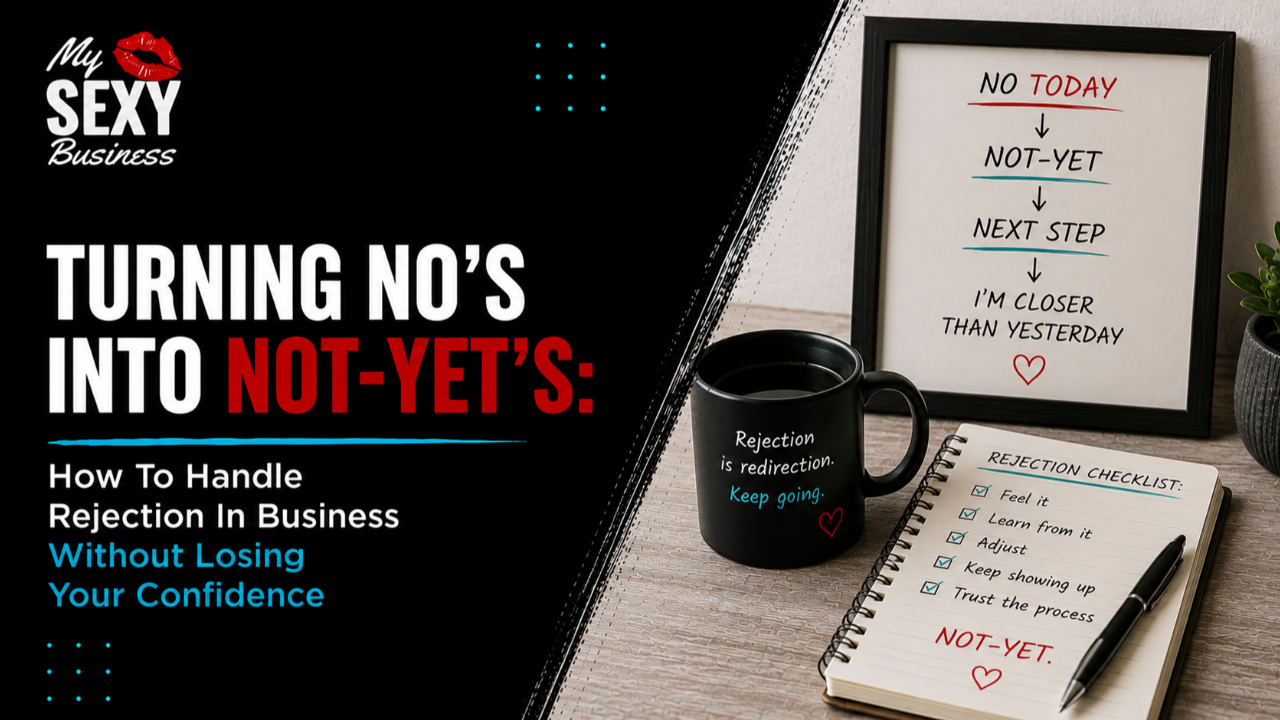
If you are building a business, you are going to hear the word “no.”
No, not right now.
No, this isn’t for me.
No response at all after you pour your heart into a launch or a pitch.
Rejection is part of the game. But for many entrepreneurs, every no feels like a verdict:
“I’m not good enough.”
“My offer is worthless.”
“I should never have tried.”
That internal story is what actually does the damage, not the no itself.
In this post, based on a Buckets and Boom Gates episode with Jill and Kim, we’re going to reframe rejection so that a no becomes a not‑yet, and a setback becomes a source of information instead of shame.
___________________________________________________________________________________________________
Why Rejection Hurts So Much
Let’s start with this: you’re not weak or overly sensitive because a no stings.
Selling, launching, and putting your work into the world is vulnerable. You are not just sending out a link; you are sharing something you care about, something tied to your skills, your story, and often your sense of identity.
So when someone says no to your offer, your brain often doesn’t hear:
“This specific person chose not to buy this specific thing at this specific moment.”
It hears:
“You’re not enough.”
“They don’t like you.”
“You shouldn’t be doing this.”
On top of that, most of us were never taught how to process no in a healthy way. We grew up in systems where:
- You’re graded on performance
- You’re praised when you “win” and ignored when you don’t
- Failure is something to hide, not something to learn from
So when rejection shows up in your business, it often plugs straight into old wiring.
The shift we want you to make is this:
Rejection is feedback, not a final judgment.
A no is a piece of information. It might be painful information, but it is not a prophecy about your future or your worth.
___________________________________________________________________________________________________
Not Every No Is The Same
Part of handling rejection well is understanding that not every no is created equal.
Jill and Kim suggest looking at no’s through three lenses:
1. Not yet
2. Not this
3. Not me
1. Not Yet
This is when someone might be a good fit, but the timing, capacity, or circumstances aren’t right.
Examples:
- “I really like this, but I’m in another program right now.”
- “This sounds great, but my budget is tight this month.”
- “I’m interested… just not sure I can commit right now.”
These are not full‑stop no’s. They’re not‑yets.
With a not‑yet, the relationship is still alive. The door isn’t closed. Your job is to follow up with care, stay present, and keep serving them so that when the timing shifts, you’re the person they think of.
2. Not This
This is when the person is open to working with you, but the particular offer, format, or timing isn’t the right fit.
Examples:
- “I wish this were a self‑paced version.”
- “I’m looking for something shorter/longer.”
- “I’d love to work with you one‑on‑one instead of in a group.”
Not this no’s are incredibly valuable. They tell you something about how your offer is landing, how it’s positioned, or what other containers your audience might need.
3. Not Me
This is when someone honestly is not your person.
Examples:
- They don’t have the problem you solve.
- They don’t value your approach.
- They want something you don’t offer and don’t want to offer.
These no’s are gifts in disguise. They save you from misaligned clients, resentment, and trying to serve people you’re not meant to serve.
___________________________________________________________________________________________________
Rejection As Data, Not Drama
A big theme in the episode is moving from drama to data.
Drama sounds like:
- “No one wants this.”
- “I’m terrible at this.”
- “I should have known better.”
Data sounds like:
- “Three people said yes, seven said no. Why?”
- “People seemed confused about the offer details.”
- “Most objections were about timing and budget.”
Drama attacks you. Data informs you.
When a launch or pitch doesn’t go how you hoped, Jill and Kim recommend a simple debrief:
1. What was I trying to do?
(Grow my list, sell 10 spots, test a new offer…)
2. What actually happened?
(Numbers, responses, patterns…)
3. What seemed to work?
(Certain emails, topics, price points, audiences…)
4. What didn’t land?
(Confusing messaging, rushed timelines, channels that didn’t convert…)
5. What will I adjust next time?
(Give more warm‑up content, change the call‑to‑action, clarify the outcome…)
Notice the tone: neutral, curious, honest.
You’re reviewing your “game tape” like an athlete looking to improve performance, not a prosecutor trying to prove you’re guilty of failure.
___________________________________________________________________________________________________
Protecting Your Confidence When You Hear No
You cannot build a business with no rejection. But you can build one where rejection doesn’t wreck you every time.
Here are a few ways to protect your confidence:
1. Separate Your Identity From Results
Your last launch is not your identity.
Your conversion rate is not your worth.
A day, a month, or even a year of numbers does not define your entire story.
When you get a no, remind yourself:
- “This is about an offer, not about my value as a human.”
2. Shorten The Rejection Loop
Instead of letting a no send you into a three‑day spiral, practice shortening the loop:
- Notice the sting
- Name what you’re feeling (“disappointed,” “embarrassed,” “tired”)
- Sit with it briefly
- Move into a small, productive action
That action might be:
- Sending one follow‑up message
- Taking a 10‑minute walk to reset
- Writing down one thing you learned
Over time, your nervous system will learn that a no is survivable, and that you keep moving.
3. Create A Rejection‑Resilient Environment
You can support yourself by:
- Having at least one business friend you can text after a no
- Keeping a “wins” folder of client messages and successes
- Having a short grounding ritual for after a tough call or launch
Rejection lands differently when you have somewhere to put it besides your own chest.
___________________________________________________________________________________________________
Turning No’s Into Not‑Yets (Without Being Pushy)
When you sense that a no is more of a not‑yet or not‑this, you can follow up in ways that honor the person while keeping the door open.
Examples of gentle follow‑ups:
- “Thanks so much for considering it. Out of curiosity, was your no more about timing, budget, or fit? That helps me learn.”
- “Totally understand it’s not right for right now. If it’s okay with you, I’ll keep you in the loop if I run a different version or time this again.”
- “No problem at all. In the meantime, here’s a free resource that might still help with what you’re working on.”
Key principles:
- Respect their no
- Don’t argue or pressure
- Offer a path for future connection if it feels right
You are building a long‑term relationship, not chasing a one‑time transaction.
___________________________________________________________________________________________________
One Simple Exercise: Reframing A Recent No
To put this into practice, take a few minutes and walk one recent no through this process:
1. Write down the situation:
- What were you offering?
- To whom?
- What was the no?
2. Ask:
- Was this a not‑yet, not‑this, or not‑me?
3. Decide:
- If it was not‑yet: what’s a gentle follow‑up you can make in the next week?
- If it was not‑this: what did you learn about your offer or messaging?
- If it was not‑me: can you release this person with gratitude and move on?
4. Finish with:
- One sentence of data (“X people were interested, Y said no mostly due to Z reason…”)
- One sentence of truth about you (“I am still capable, still learning, and this is just one moment in my business.”)
___________________________________________________________________________________________________
Your Story Is Not Defined By Your No’s
Rejection is inevitable. But internalizing rejection as your identity is optional.
If you’re consistently putting your work in front of people, you are going to hear no.
You’ll also hear “not yet,” “not this,” and “not you—but someone else will say yes.”
The businesses that last are rarely the ones that never get rejected. They are the ones that learn to interpret rejection well:
- As feedback instead of a verdict
- As information instead of humiliation
- As a chance to grow instead of a reason to quit
You don’t need fewer no’s to build a strong business.
You need a healthier way to walk through them.
And that starts with this simple shift:
- “This no is not the end of the story. It’s just one page. I get to decide what I write on the next one.”
If you missed the conversation between Kim and Jill on their podcast Buckets and Boom Gates, you can listen to Episode #128 here
Looking for a Community?
We believe business is better together!
The My Sexy Business Community has many facets so we encourage you to explore the different creative solutions we offer for business owners and entrepreneurs ... like support, accountability, strategy, and so much more. We hope to see you on the inside! Click here to join us.
To connect and find out more about Kim or how to create a sexy business for a sexy life, you can reach her and the My Sexy Business Team at www.mysexybusiness.com.
And to connect with Jill Olish go straight to her website www.mamaoutspoken.com and you’ll find her there!
Our one & only choice for us & all our clients to build our online brands and presence is this all-in-one platform!
And our favorite for streaming live is this!
Blog #180
