
The “Ugly Baby Syndrome” Of Publishing: Why Your Book’s Sales Don’t Define Its Worth
Aug 12, 2026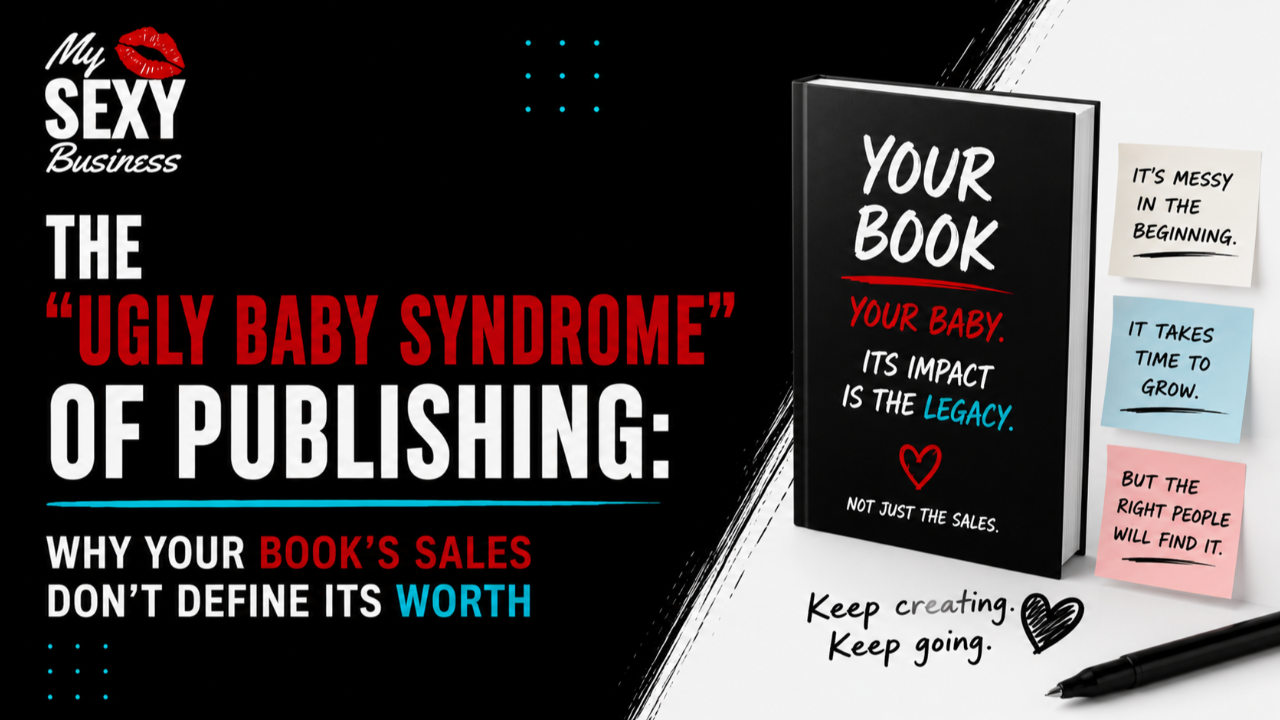
You poured your heart into your book. You wrestled with chapters, second-guessed sentences, and finally hit publish. Then the numbers came in… and they weren’t what you hoped.
Suddenly you’re convinced you have what we call “ugly baby syndrome”: if your book doesn’t sell, you assume your “baby” is ugly. Not good enough. Not wanted. Not worth it.
In this episode of the Buckets and Boomgates podcast, we (Jill Olish and Kim White) unpack this painful, but common experience for authors and creators. This blog post expands on that conversation, so you can see your book—and yourself—through a healthier, more accurate lens.
___________________________________________________________________________________________________
What Is “Ugly Baby Syndrome” In Publishing?
“Ugly baby syndrome” is the belief that if your book isn’t selling, there must be something fundamentally wrong with it—or with you.
It shows up as thoughts like:
- No one bought my book, so it must be bad
- If it was really good, it would’ve gone viral
- I guess I’m not a real writer after all
- I shouldn’t have published this; it’s embarrassing
Here’s the truth most authors never hear: low sales do not automatically equal a low-quality book. There are many reasons a good, even great, book doesn’t take off right away—and most of them have nothing to do with your talent or your message.
___________________________________________________________________________________________________
The Difference Between Book Quality And Book Sales
Publishing has two major parts:
1. The book you create (your content, message, craft)
2. The path you give it to reach people (your marketing, positioning, and timing)
Most of us focus almost entirely on the first part. We rewrite. We edit. We polish. We obsess over interior layout and cover design. Then, we quietly upload it and cross our fingers.
When the numbers are low, we assume the problem is the book itself.
But in reality, book sales are influenced by:
- Visibility: Do enough of the right people even know your book exists?
- Positioning: Is it clear who the book is for and what problem it solves?
- Timing: Is your audience ready for this message right now?
- Offer structure: Are you making it easy and compelling to buy?
- Consistency: Are you talking about your book once…or over and over in different ways?
A powerful book with weak visibility will almost always be outperformed—at least temporarily—by an average book with strong visibility and clear positioning.
That doesn’t mean you should compromise on quality. It means you need to stop reading your sales numbers as a verdict on your worth.
___________________________________________________________________________________________________
Why Authors Take It So Personally
Books feel different from other offers. They feel closer to our identity.
When you write, you are:
- Telling your story
- Sharing your hard-earned lessons
- Processing your own healing and growth
- Putting your perspective into the world, where it can be praised or criticized
So when the response is quiet—or critical—it feels like *you* are being rejected, not just your product.
Here’s what’s really happening:
- Readers are busy and overwhelmed
- Algorithms don’t automatically favor new authors
- Most of your audience has to hear about your book many times before they buy
- People may love your content but not be ready to invest yet
None of that equals, “Your book is ugly” or “You shouldn’t have written it.” It means you’re in the early, awkward, extremely normal phase of getting your work into the world.
___________________________________________________________________________________________________
Five Key Shifts To Heal “Ugly Baby Syndrome”
Here are five core ideas from our conversation that can help you move from shame and discouragement into clarity and momentum.
1. Separate Your Identity From Your Numbers
You are a whole person. You were valuable before you ever wrote a word. Sales metrics track behavior, not worth.
Try this reframe:
- Instead of: “Only ten people bought my book; I failed.”
- Use: “Ten people thought my book was worth spending money on. Now, how can I reach the next ten?”
When you separate your identity from your numbers, you can look at sales data more objectively and make smart changes—without collapsing into self-judgment.
2. Treat Your Book As A Beginning, Not A Final Judgment
Publishing is not the finish line. It’s the "start" of your book’s life.
Some books take months or years to find their audience. Many authors see a slow start, then a surge when:
- They speak on the right podcast
- They get in front of a new community
- They repurpose the book into a workshop, course, or talk
- They link the book to a clear next step (coaching, membership, or program)
When you see your book as a long-term asset instead of a one-time launch event, the pressure eases. You don’t have to “make it” in week one. You can keep growing into the author you’re becoming.
3. Look At The Real Problems You’re Solving
Sometimes “it’s not selling” is really “it’s not yet clear.”
Ask:
- Who is this book "really" for?
- What problem are they aware they have?
- How does this book help them move from where they are to where they want to be?
- Is that journey obvious from the cover, title, and description?
Often, “ugly baby syndrome” softens when you realize your book might just need a clearer doorway—better messaging, a more direct subtitle, a stronger promise.
You don’t have to throw out the baby. You might just need to change the outfit.
4. Learn To Talk About Your Book Without Apologizing
A lot of authors feel uncomfortable promoting their own work. They:
- Mention it once and hope people “get the hint”
- Downplay it with jokes or disclaimers
- Wait for someone else to bring it up
But your book is a solution, a comfort, or a companion for someone who’s struggling with something you understand deeply.
Try talking about your book like this:
- “If you’re feeling [problem], I wrote this book to help you with [specific outcome].”
- “When I went through [experience], I wish I’d had a resource like this. That’s why I wrote it.”
- “If this episode resonates with you, the book is where I go deeper into the how-tos.”
No begging. No apologizing. Just an invitation.
5. Let Feedback Refine You, Not Define You
Not every review will be glowing. Not every reader will get your message. That’s normal.
Instead of reading every response as a verdict, ask:
- Is there a pattern in the feedback that could make future projects even better?
- Is this critique about my *craft*, my *clarity*, or just personal preference?
- Can I use what I’m learning here to improve my next book, launch, or offer?
There is a big difference between:
- “I’m terrible; I should stop.”
- “I’m growing; here’s what I’ll do differently next time.”
One ends your journey. The other matures your voice.
___________________________________________________________________________________________________
How To Keep Moving Forward As An Author
If you’re staring at your sales numbers and thinking, “I have an ugly baby,” you are not alone. Every creator who has ever shipped something meaningful has faced that moment of vulnerability.
Here’s your next step:
- Look at your book as an asset, not a mistake
- Get honest about visibility and clarity, not your worth
- Decide one small, specific action you can take this week to put your book in front of more of the right people
Maybe that’s:
- Turning a chapter into a blog post or live video
- Sharing a personal story from the book on social media with a direct link to buy
- Offering a bonus (like a mini workshop or Q&A) for readers who purchase this month
- Pitching yourself to a podcast or community that serves your ideal reader
Your book is not an ugly baby. It’s a brave act of generosity. It may still be finding its people. Let it grow. Let "you" grow.
And if you’re listening to Buckets and Boomgates, know this: you’re in good company. We’re right here with you, talking honestly about what it really looks like to publish, promote, and keep creating— even when the numbers don’t match the dream… yet.
If you missed the conversation between Kim and Jill on their podcast Buckets and Boom Gates, you can listen to Episode #126 here
Looking for a Community?
We believe business is better together!
The My Sexy Business Community has many facets so we encourage you to explore the different creative solutions we offer for business owners and entrepreneurs ... like support, accountability, strategy, and so much more. We hope to see you on the inside! Click here to join us.
To connect and find out more about Kim or how to create a sexy business for a sexy life, you can reach her and the My Sexy Business Team at www.mysexybusiness.com.
And to connect with Jill Olish go straight to her website www.mamaoutspoken.com and you’ll find her there!
Our one & only choice for us & all our clients to build our online brands and presence is this all-in-one platform!
And our favorite for streaming live is this!
Blog #176
