
CEO Habits: Planning, Money & Focus That Actually Move Your Business Forward
Aug 05, 2026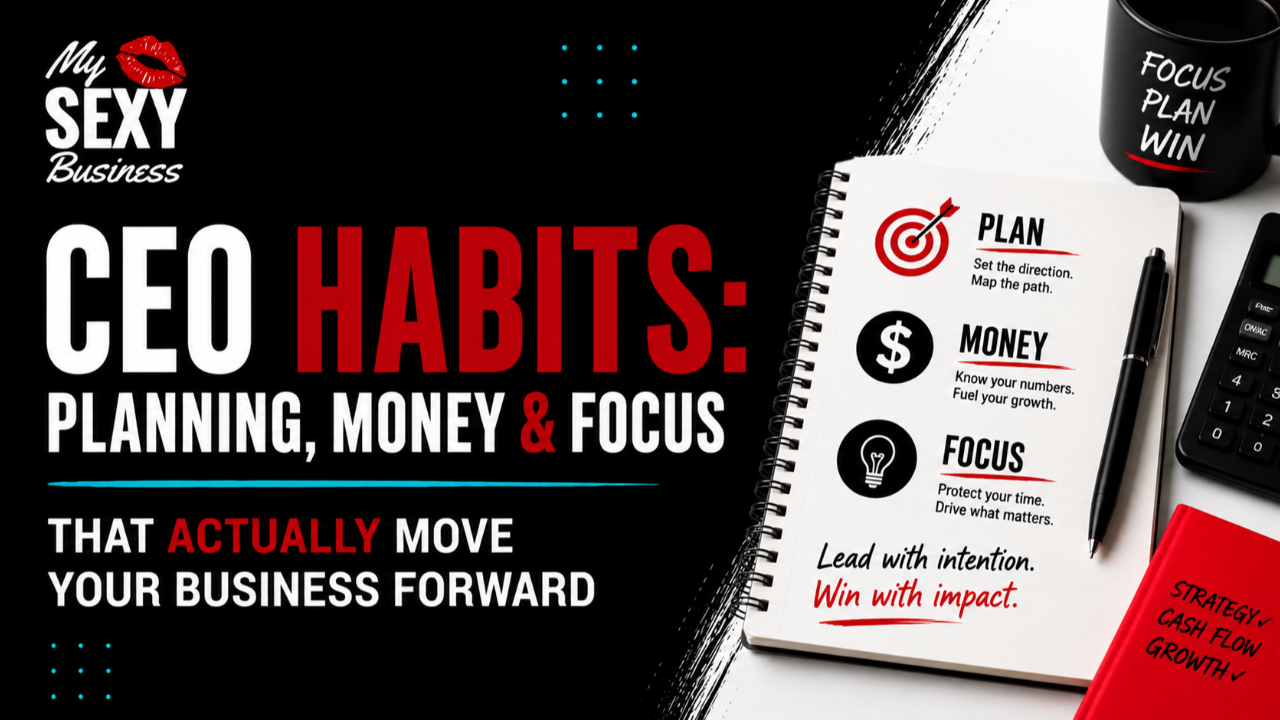
If you run a business, you’ve probably heard you need “CEO habits.” But what does that actually mean in real life, beyond a pretty morning routine and a full planner? In our Buckets & Boom Gates conversation, we dug into the habits that show up where it matters most: your calendar, your bank account, and your ability to focus.
This isn’t about motivation or perfection. It’s about simple, repeatable behaviors around planning, money, and focus that keep your business moving, even when life is messy. And yes, we’ll talk about the difference between being messy and being sloppy, because that distinction can change how you lead.
What Are “CEO Habits” Really?
When we say “CEO habits,” we’re not talking about waking up at 4 a.m. or drinking a specific green juice. We’re talking about the quiet, often boring behaviors you repeat that protect and grow your business over time.
CEO habits tend to show up in three places:
-
How you plan your week and projects
-
How you relate to and manage your money
-
How you protect your attention and focus
They’re not one-time decisions or occasional bursts of energy. They are rhythms. They are the things you do whether you feel motivated or not.
There’s also a key distinction here: working in the business versus working on the business. CEO habits live in the “on” category. They’re the planning, reviewing, deciding, and course-correcting that keep the business healthy, even while you’re doing day-to-day work.
Planning Habits That Actually Move the Needle
A lot of entrepreneurs equate planning with rewriting the same long to-do list every week. That’s not a CEO habit. That’s a stall tactic.
A simple CEO planning habit can look like this:
-
Once a week, you sit down for 20–30 minutes and ask:
-
What matters most in the next 7 days to move the business forward?
-
What is my real capacity this week?
-
If everything fell apart, what are the few things that must still get done?
-
From there, choose one needle-moving task per day, not fifteen. For example:
-
Monday: Finalize the sales page
-
Tuesday: Record two podcast episodes
-
Wednesday: Review financials and invoices
-
Thursday: Send an email with a clear offer
-
Friday: Review metrics and plan next week
The key is that this planning time lives on your calendar like a real appointment. You don’t wait until everything feels calm or organized. You plan with the reality you have, not the fantasy week you wish you had.
That’s where “messy” comes in: you’re allowed to plan with imperfect information, shifting schedules, and half-finished ideas. You’re making decisions anyway.
Money Habits: Behavior Over Hope
Money is one of the clearest places where CEO habits either exist or don’t. You can tell a lot about a business by its money behaviors:
-
Does the owner regularly look at the numbers?
-
Is there a clear separation between business and personal finances?
-
Are there simple, repeatable rules in place?
A practical CEO money habit could be a weekly 15-minute money check-in where you:
-
Look at what came in
-
Look at what went out
-
Note what big expenses are coming up
-
Decide on one money-related action (send invoices, adjust an offer, follow up on a proposal)
Some straightforward rules that help:
-
Separate business and personal accounts
-
Pay yourself something regularly, even if it’s small at first
-
Set aside a percentage for taxes without drama
-
Know your basic runway: how many months you can cover your essential expenses
None of this requires you to be a “numbers person.” It requires you to be a responsible decision-maker. The habit is simply showing up to look at your numbers and make one clear decision each week, even when it’s uncomfortable.
Again, messy is okay. Your bookkeeping software doesn’t have to be perfect. Your categorization might lag behind. But if you’re engaging with the numbers regularly, you’re being a CEO.
Focus Habits In A Distracting World
You can have great plans and decent money habits, but if your attention is constantly scattered, important work won’t get finished.
CEO focus habits are about intentionally creating pockets of protected time. For example:
-
Two 60–90 minute deep-work blocks each week, on your calendar
-
A simple pre-work ritual: close extra tabs, silence notifications, phone in another room
-
One non-negotiable task you complete before you open your inbox or messages
You don’t need a perfectly quiet life. You need a few protected hours where you’re not reacting to everyone else’s priorities.
A powerful question is: What absolutely must move forward this week, even if I answer fewer emails or messages? CEO focus habits are built around that answer.
And just like with planning and money, this is about behavior, not mood. You don’t wait to feel inspired to sit down for your focus block. You sit down for your focus block and let inspiration catch up if it wants to.
Behavior vs Motivation
It’s tempting to think that if you could just feel more motivated, everything would click. But motivation is unreliable. Some days it’s there; many days it’s not.
Behavior is what you do anyway.
Think about brushing your teeth: you’re not giving yourself a pep talk about dental hygiene twice a day. You just do it. CEO habits work the same way. They become the default.
Instead of asking, “How can I feel more motivated?” try asking:
-
What is the smallest planning behavior I can commit to every week?
-
What is the simplest money behavior I can stick to, no matter what?
-
What is one focus habit I’m willing to protect?
You build confidence not by waiting for a feeling, but by stacking small, consistent actions over time.
Messy vs Sloppy: A Crucial Distinction
“Messy” and “sloppy” can look similar on the surface, but they are very different underneath.
-
Messy is imperfect but engaged. You’re trying, adjusting, showing up.
-
Sloppy is avoidant and careless. You’re ignoring what needs attention and rationalizing it away.
Here’s how that plays out in our three areas:
In planning:
-
Messy: Your plan is scribbled on sticky notes, but you have a clear top 3 for the week and you refer back to it.
-
Sloppy: Everything stays in your head, you start each day reacting, and you hope the urgent stuff is also the important stuff.
In money:
-
Messy: You track income and expenses in a basic spreadsheet and catch up weekly, even if it isn’t beautifully organized.
-
Sloppy: You avoid logging in, avoid looking at numbers, and wait for tax time or your accountant to tell you what’s going on.
In focus:
-
Messy: You block time and sometimes drift, but you notice and pull yourself back.
-
Sloppy: You never block time, you respond to every ping instantly, and then wonder why no big projects ever get finished.
Messy is completely allowed. Messy is human. Messy still moves the business forward. Sloppy is where things silently break over time.
The invitation isn’t to become a perfectly polished robot. It’s to move from sloppy neglect to messy engagement.
A Simple CEO Habit Challenge
Rather than overhauling your entire life, pick one small CEO habit to start with this week. Keep it specific and scheduled.
You might choose:
-
Planning: “Every Friday at 3 p.m., I spend 20 minutes planning next week and choosing my top 3 priorities.”
-
Money: “Every Monday at 10 a.m., I log into my accounts, note what came in and what went out, and make one money decision.”
-
Focus: “Twice a week, I block 90 minutes for deep work and keep my phone in another room.”
Write it down. Put it in your calendar. Treat it like a commitment to your future self and your business, not a nice idea.
And when it goes off the rails one week (because it will), don’t use that as proof you’ve failed. Use it as proof you’re human… and then bring the habit back.
Final Thoughts
Strong businesses are rarely built on dramatic breakthroughs. They’re built on boring, consistent CEO habits that happen when no one is watching. Planning that reflects reality. Money check-ins that happen even when the numbers sting. Focus blocks that keep your most important work moving.
You don’t have to do this perfectly. You just have to decide you’re willing to show up, messy and committed, instead of staying in sloppy avoidance.
Start with one habit. Let it be small. Let it be simple. Let it be consistent. That’s how you start behaving like the CEO your business actually needs.
If you missed the conversation between Kim and Jill on their podcast Buckets and Boom Gates, you can listen to Episode #125 here
Looking for a Community?
We believe business is better together!
The My Sexy Business Community has many facets so we encourage you to explore the different creative solutions we offer for business owners and entrepreneurs ... like support, accountability, strategy, and so much more. We hope to see you on the inside! Click here to join us.
To connect and find out more about Kim or how to create a sexy business for a sexy life, you can reach her and the My Sexy Business Team at www.mysexybusiness.com.
And to connect with Jill Olish go straight to her website www.mamaoutspoken.com and you’ll find her there!
Our one & only choice for us & all our clients to build our online brands and presence is this all-in-one platform!
And our favorite for streaming live is this!
Blog #174
